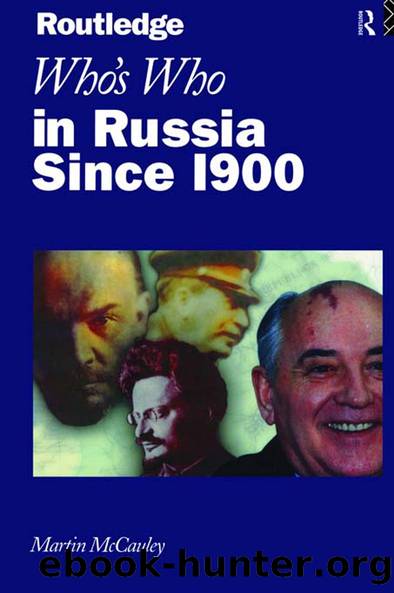
Who's Who in Russia since 1900 by Martin McCauley Martin Mccauley
Author:Martin McCauley, Martin Mccauley [Martin McCauley, Martin Mccauley]
Language: eng
Format: epub
Tags: History, General, Political Science
ISBN: 9781134772131
Google: q2RF5YGDZAsC
Publisher: Routledge
Published: 2002-09-11T22:35:03+00:00
L
Landau, Lev Davydovich (1908â68), a brilliant Soviet theoretical physicist, who was born into a Jewish family in Baku and graduated from Leningrad State University in 1927. He studied in Denmark, England and Switzerland and in 1932 he moved to the Physicotechnical Institute, Kharkov. In 1937 he joined a theoretical group at the Institute of Physical Problems, Moscow. He fell foul of the authorities and was imprisoned, 1938â9. He worked with Petr Kapitsa and became a member of the USSR Academy of Sciences. He was awarded the Nobel Prize for Physics in 1962. David Holloway: Stalin and the Bomb, New Haven and London, 1994.
Landsbergis, Vytautas (b. 1932), the first President of the Republic of Lithuania after it had regained its independence, Landsbergis however concentrated too much on politics and neglected the economy so that he lost his position in 1993. He was born in Kaunas and his father was a famous architect. Landsbergis became a musicologist at the Conservatory. Under glasnost, a Lithuanian national movement, Sajudis, emerged. Landsbergis was elected its first chair in November 1988 and when independence was declared in March 1990 he was elected its first president. The declaration of independence was suspended but the demise of the Soviet Union in December 1991 led to worldwide recognition of Lithuanian independence. Landsbergis engaged in a self-defeating confrontation with Moscow and when the first democratic elections after independence were held in September 1992, the former Communists, led by Algirdas-Mikolas BRAZAUSKAS, swept the board. Landsbergis's comment was that the electorate were stupid. Presidential elections were held in February 1993 and Brazauskas won 60.1 per cent of the vote. Lithuania thus became the first post-communist state to elect ex-Communists back into power in democratic elections.
Latsis, Otto Rudolfovich (b. 1934), one of the leading economic journalists of the perestroika period, Latsis was born in Moscow and is of Latvian origin. He graduated from Moscow State University in journalism, 1956, began his journalistic career on a Sakhalin newspaper and joined the Communist Party in 1959. He worked on Izvestiya as an economic observer, 1964â71, and then worked in Prague on World Marxist Review, until 1975. He transferred to the Institute of Economics of the World Socialist System, USSR Academy of Sciences, becoming head of a department. He also acquired his doctorate in economics (PhD). In 1986 he moved to Kommunist and contributed to the renaissance of the Party's theoretical journal, strongly supporting reform. In 1987 he became its deputy editor. He was a member of the Central Committee, July 1990âAugust 1991.
Lebed, Aleksandr Ivanovich (b. 1950), one of the Russian military officers whose career took off rapidly after the failure of the August 1991 coup. He was born in Novocherkassk into a Ukrainian family. He graduated from the Ryazan Higher Air Force Officersâ Technical College, 1973, and the Frunze Military Academy, 1985. He joined the Communist Party in 1972. He began his career as a commander of a student platoon at the Ryazan Technical College (the company commander was the future General Pavel GRACHEV). He served in Afghanistan, 1981â2, as the commander of a paratroop battalion of the 40th Army.
Download
This site does not store any files on its server. We only index and link to content provided by other sites. Please contact the content providers to delete copyright contents if any and email us, we'll remove relevant links or contents immediately.
| Anthropology | Archaeology |
| Philosophy | Politics & Government |
| Social Sciences | Sociology |
| Women's Studies |
The Secret History by Donna Tartt(19102)
The Social Justice Warrior Handbook by Lisa De Pasquale(12197)
Thirteen Reasons Why by Jay Asher(8918)
This Is How You Lose Her by Junot Diaz(6893)
Weapons of Math Destruction by Cathy O'Neil(6284)
Zero to One by Peter Thiel(5807)
Beartown by Fredrik Backman(5766)
The Myth of the Strong Leader by Archie Brown(5512)
The Fire Next Time by James Baldwin(5454)
How Democracies Die by Steven Levitsky & Daniel Ziblatt(5224)
Promise Me, Dad by Joe Biden(5157)
Stone's Rules by Roger Stone(5090)
A Higher Loyalty: Truth, Lies, and Leadership by James Comey(4966)
100 Deadly Skills by Clint Emerson(4931)
Rise and Kill First by Ronen Bergman(4797)
Secrecy World by Jake Bernstein(4756)
The David Icke Guide to the Global Conspiracy (and how to end it) by David Icke(4722)
The Farm by Tom Rob Smith(4517)
The Doomsday Machine by Daniel Ellsberg(4493)
